



附件产品
Pitel Paste
用于电力电子的高性能非导电热界面化合物
Pitel Paste Formula AZ-01是Magna-Power的标志性导热膏配方,一种非导电导热化合物,专为满足电力电子制造商绝大多数半导体热界面需求而设计。Pitel Paste AZ-01在击穿电压、长期热阻、粘度与成本之间取得了完美的平衡。
可重复密封容器(旋盖)• 每个236 ml(8盎司)• 每个容器附带塑料抹刀
| SKU | 描述 | 价格 | 数量 |
|---|---|---|---|
| AZ-01-A-236 | AZ-01-A-236 |

与专家交谈
预约与 Magna-Power 的通话
选择适合您的时间,可选择添加同事,然后通过电子邮件接收带链接的通话邀请,与 Magna-Power 的应用工程师讨论您的需求。


Overview
Pitel Paste AZ-01 is Magna-Power’s signature thermal paste formula, designed to satisfy the majority of semiconductor thermal interface requirements for power electronics manufacturers. AZ-01 finds the perfect balance among long-term thermal resistance, viscosity and cost.
Pitel Paste AZ-01 uses a mixture of high-concentration powderized aluminum and zinc oxide suspended in non-conducting silicone oil. This thermal paste formulation was designed specifically for power electronics applications, filling microscopic voids between semiconductors and heatsinks, resulting in a better thermal transfer and ultimately, improved performance capabilities. AZ-01, refined and validated over 8 years by Magna-Power, has a proven track record for delivering superior thermal performance in some of the most demanding power electronics applications.
A wide range of deposition methods are supported for a variety of production needs, including manual deposition, automated dispensing, pneumatic dispensing, and stencil printing.
Pitel Paste is manufactured in the USA at Magna-Power’s manufacturing facility and is compliant with both REACH and RoHS directives.
Packaging
The available packaging and bundling for Pitel Paste Formula AZ-01.
| Package Type | Package Description | Volume |
|---|---|---|
| A | Resealable Container | 236 ml (8 oz) |
| C | Sample Size Luer Lock Syringe |
1 ml (0.03 oz) |
Thermal Paste in Power Electronics Applications
With internal capabilities that include metal and heatsink fabrication, CNC machined surface finishing, and power module assembly, Magna-Power is uniquely positioned to address power semiconductor heat extraction with a vertically integrated approach. Over a period of 8 years, Magna-Power iterated on its own thermal compound formulation, evaluating it through the lens of power electronics applications and today playing a critical role in the company’s ability to deliver among the most power dense programmable power supplies on the market.
A thermal interface material between two metals can offer up to two orders of magnitude drop in thermal resistance. A high-performing thermal paste can help achieve the highest-performing thermal bond on a production-scale.
Thermal Resistivity for Power Semiconductors
While thermal interface manufacturers often emphasize thermal conductivity as their key performance metric, this specification does not quantify the device-to-surface realities found in power electronic assemblies.
The applied metric for engineers is thermal resistivity, which benchmarks void-filling thermal paste performance for power semiconductors, measuring how easily heat can be conducted between two surfaces. In power electronics, thermal resistance between power semiconductors and heatsinks plays a critical role in product performance, with lower thermal resistance allowing product designers to achieve greater power densities.
Temperatures of heatsink mounted power semiconductors are commonly modeled using a thermal equivalent circuit with thermal resistances (Rθ), where the power dissipated in a device (PLOSS) is converted directly into heat:
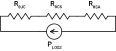
Where:
- RθJC: Thermal resistance of semiconductor junction to case; native to the semiconductor fabrication.
- RθCS: Thermal resistance of the case to heat sink surface; describes the thermal interface material and surface contact and conditions.
- RθSA: Heatsink to ambient environment surrounding the package; provides a sink for heat.
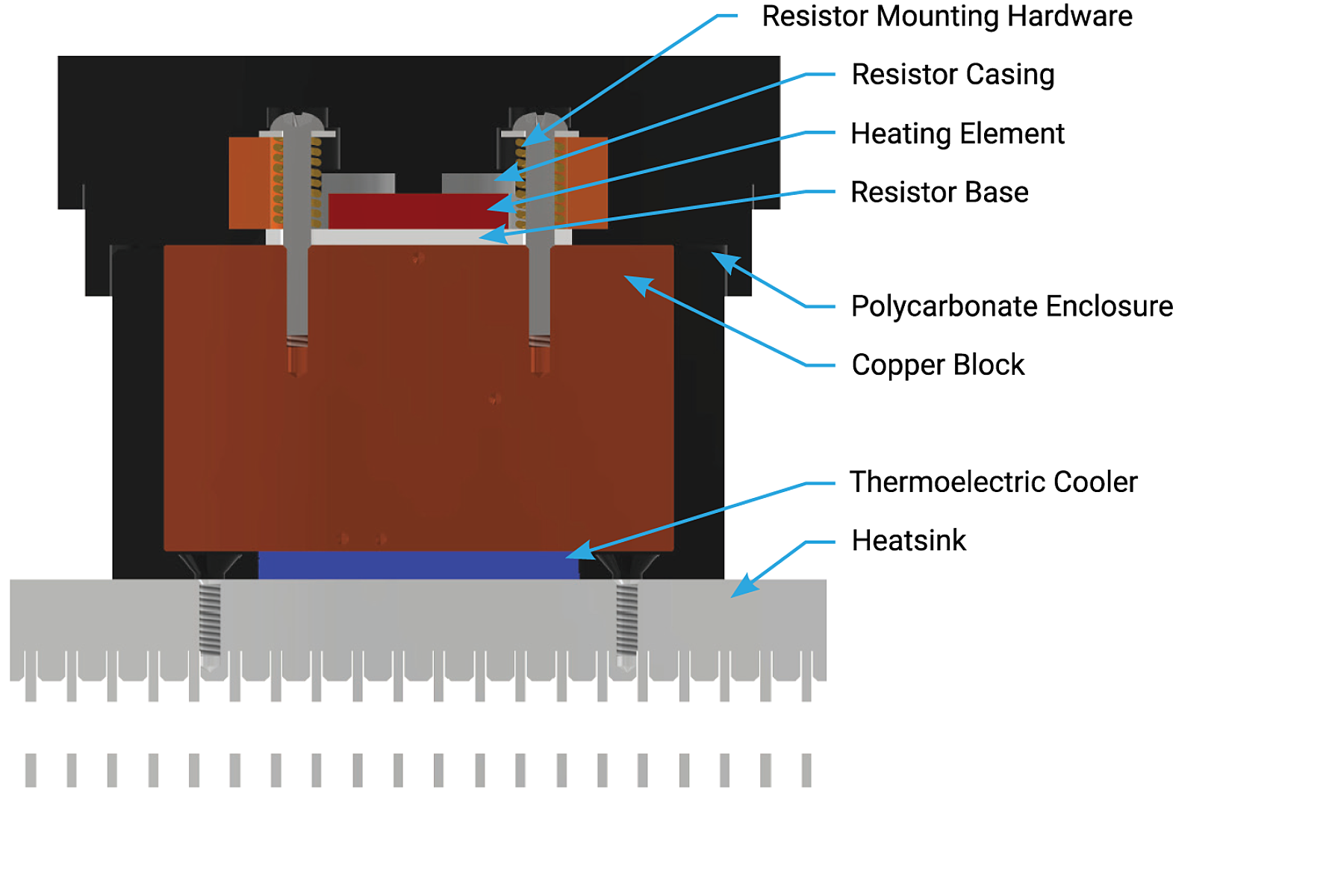
In addition to using conventional thermal conductivity measurement devices, test apparatuses were developed to evaluate thermal resistance (RθCS) in power electronics applications using various thermal compounds, as shown in Figure 2. The results of Magna-Power’s thermal resistivity measurements using this apparatus are shown in Figure 1.
Application Methods and Other Considerations
Having produced power supplies for over 40 years, with power density as a critical design criterion, Magna-Power has evaluated numerous thermal interface materials. Beyond just the thermal resistance, there are practical considerations, such as:
- Breakdown Voltage: Many pastes are formulated for low voltage integrated circuit cooling, allowing much higher thermal conductivity but with a much lower breakdown voltage; often times this specification is not even provided. For non-conducting power electronics applications, a high breakdown voltage is required; a testing standard is provided by ASTM D149 for this specification.
- Viscosity: Many high-performing pastes were thick and difficult to dispense and spread evenly.
- Separation: Thinner pastes were easy to apply, but separate over time in the dispensing containers, requiring a secondary operation for mixing before application.
- Cost: Paste that utilized exotic materials achieved only marginal performance gain with a significant price premium.
- Test Standards: Low cost thermal pastes with extreme performance claims did not reference any applicable standards to validate their performance claims. Many of these claims could not be reproduced by certified third party testings facilities using relevant ASTM standards.
Countless iterations of Pitel Paste were formulated to find the right balance of performance with practicality for medium-to-high volume production needs in power electronics applications. Pitel Paste Formula AZ-01 achieves excellent thermal performance in power electronics applications, with minimal separation and a long shelf-life, all while supporting a variety of dispensing mechanisms, such as: syringes, stencils, and volumetric dispensing.
Today, with over 200 megawatts of Magna-Power DC power supplies in the field utilizing Pitel Paste, Magna-Power is pleased to offer power electronics manufacturers the same benefits it has achieved with a well-balanced high-performing thermal compound: Pitel Paste Formula AZ-01.
规格如有变更,恕不另行通知。除非另有说明,所有规格均在产品的最大额定值下测量。
Physical Specifications
Performance Specifications
23.87 @ 10 kHz
0.00390 @ 10 kHz